


Description
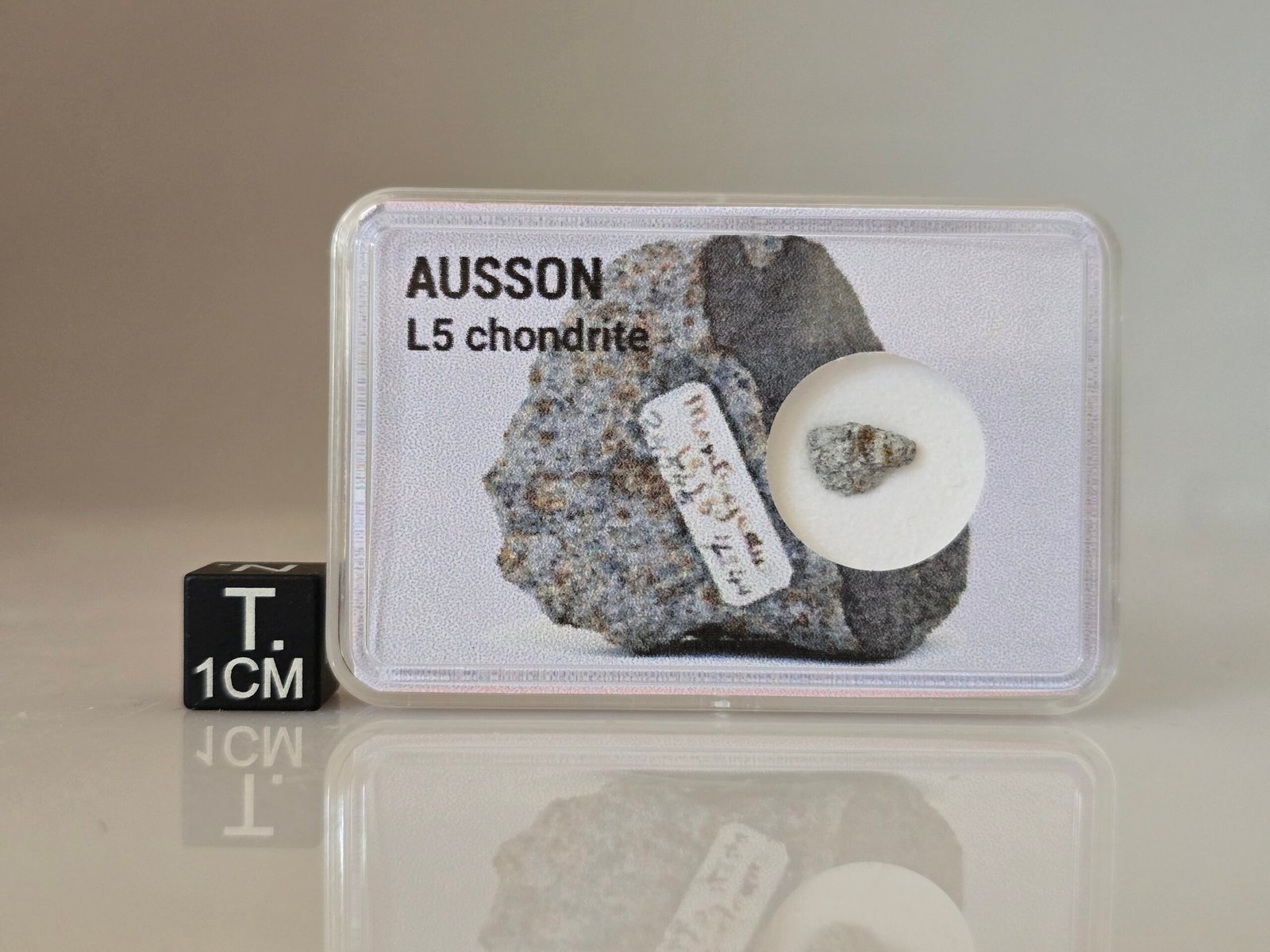
0.168g fragment. Sold in a box with label/certificate.
Early in the morning on December 9, 1858, residents of the Haute-Garonne department observed a bright fireball in the sky and distinctly heard a loud explosion followed by a continuous rumbling sound.
According to witnesses, the meteor moved from northeast to southwest. In 1859, Mr. Filhol suggested the trajectory actually ran from southwest to northeast, as the fireball was reportedly sighted successively at Rieumes, Noé, and Aurignac before falling near Montréjeau. He evidently reversed the path, given that these communes are aligned on a map along a northeast-to-southwest axis; we will adopt this latter trajectory. Notably, however, the light phenomenon was not observed in Toulouse—or at least no witnesses reported it.
Two meteorites were recovered: one fell in a field at the foot of the slope leading to Montréjeau, near the village of Ausson, weighing between 40 and 45 kg; the other landed on a barn belonging to Madame Jeanne-Marie Capéran, next to the church in Clarac, and weighed between 8 and 10 kg. The two locations are five kilometers apart.
It was also reported that a hole similar to the one at Ausson was spotted in the commune of Cassagnabère-Tournas, located more than 20 kilometers away. However, it appears no stone was found there…
The two meteorites recovered at Ausson and Clarac met an unfortunate fate: they were broken up by local residents, who shared the fragments among themselves. The parish priest of Clarac and a few prominent locals even engaged in a small-scale trade of the meteorite pieces. Fortunately, members of a commission established by the Toulouse Academy of Sciences—comprising Messrs. Petit, Leymerie, and Filhol managed to acquire fine specimens from the fall. Although the event occurred nearly 160 years ago, it would be worthwhile to go door-to-door in the towns surrounding Montréjeau in an attempt to track down further fragments of this meteorite.
A year after the fall, M. Filhol published the initial analysis in the *Mémoires de l’Académie impériale des sciences, inscriptions et belles-lettres de Toulouse*. Then, in 1859, G. Chancel and A. Moitessier updated the analysis of the Ausson meteorite by applying protocols popularized by Berzelius.