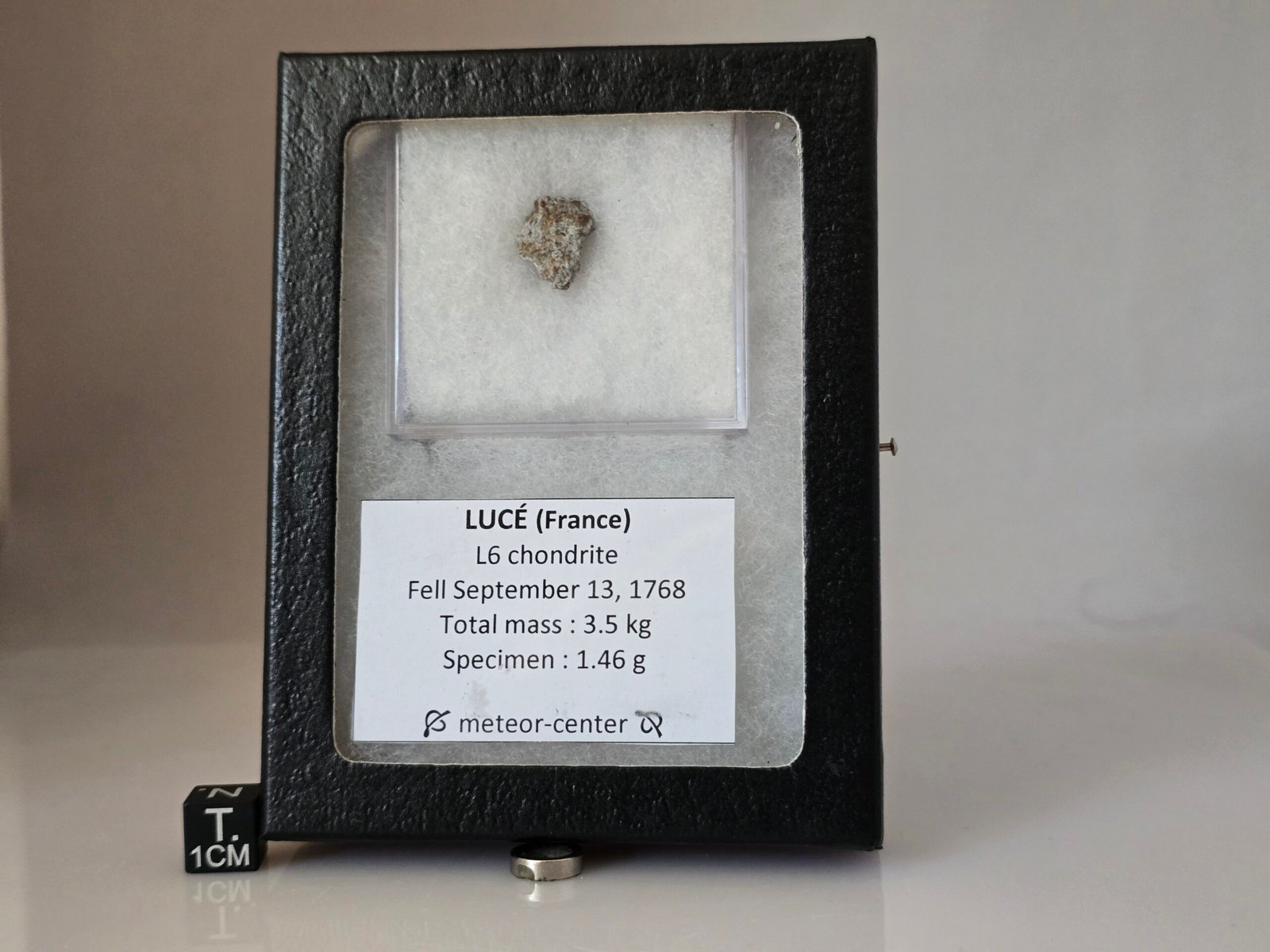
Description
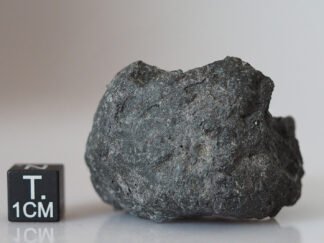
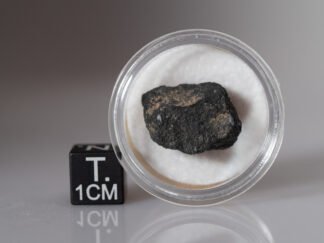
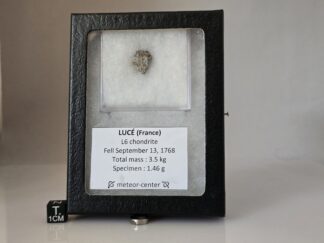
1.46g fragment sold in a box with label/certificate.
On September 13, 1768, around 4:30 p.m., a meteor was observed near the Château de la Chevallerie, two kilometers west of Le Grand-Lucé in the Sarthe region. A dull boom followed by a whistling sound was heard across the area.
At the same moment, at “Périgné”—located three leagues from Le Grand-Lucé—farm workers looked up and saw an opaque mass heading toward them; it landed on “a lawn along the main road to Le Mans.” They found a large stone in the ground, which they described as being very hot.
Abbé Bachelay acquired a fragment of the meteorite and sent it to the Academy of Sciences in Paris. The institution appointed a commission comprising Auguste-Denis Fougeroux de Bonderoy, Louis Claude Cadet de Gassicourt, and Antoine-Laurent Lavoisier. They analyzed the meteorite and found it to contain 55.5% vitrified earth, 36% iron, and 5.5% sulfur, based on the technical capabilities and knowledge of the time.
This analysis is considered the first ever performed on a meteorite; however, the scientists concluded that it was a terrestrial rock—”pyritic sandstone”—and that it “did not originate from thunder, did not fall from the sky, and was not formed by mineral matter melted by the fire of thunder.”
I assume this refers to Parigné-l’Évêque, a town located 11 kilometers (approximately three leagues) from Le Grand-Lucé, on the road to Le Mans.