Description
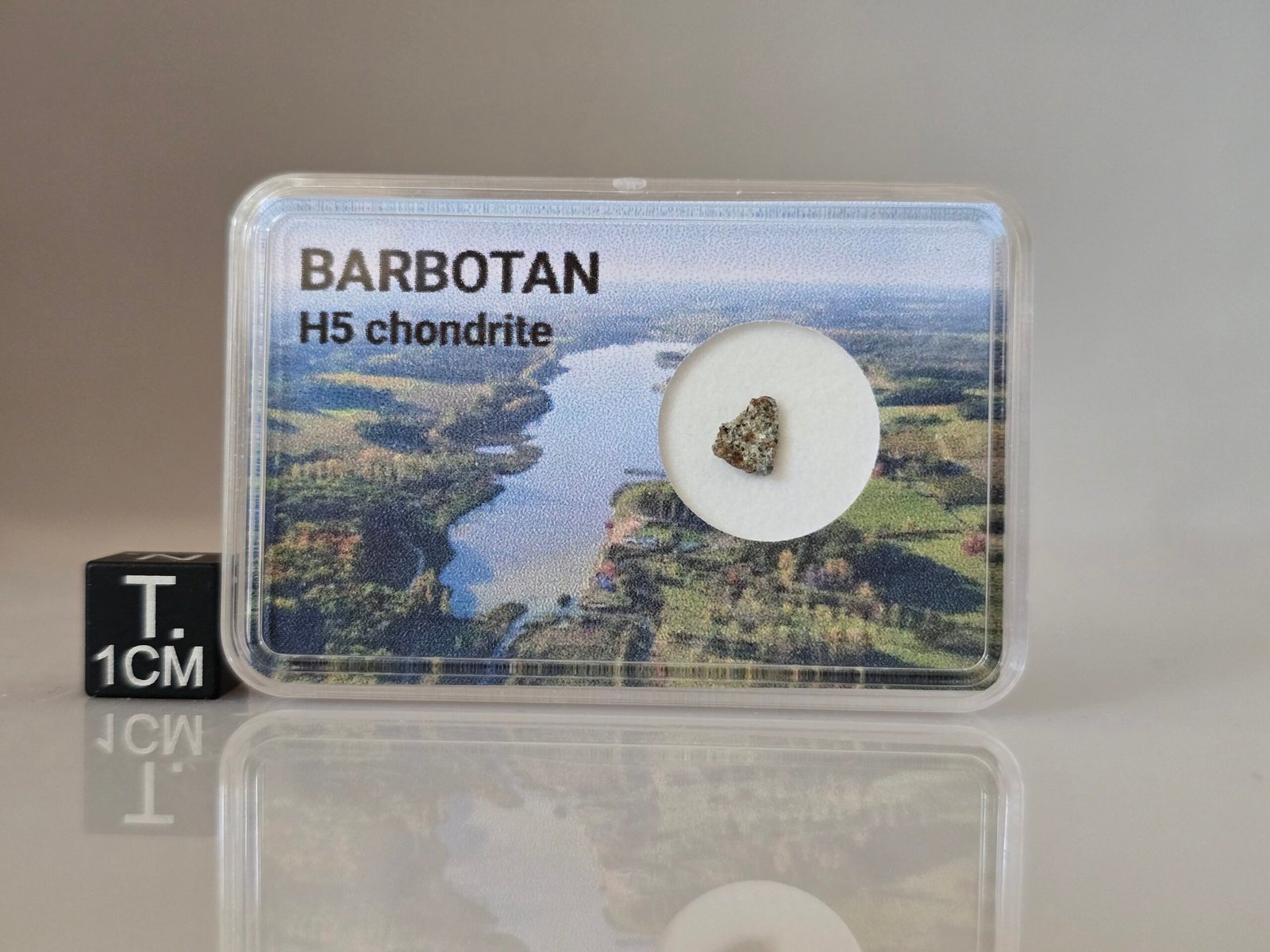
0.073g fragment sold in a box with label/certificate.
On Saturday, July 24, 1790, around 9:30 p.m., Messrs. de Carrit-Barbotan and Baudin were walking in the courtyard of the Château de Mormès. Although the sky was calm and cloudless, they suddenly observed an intense glow. Looking up, they saw a fireball passing overhead, moving from south to north according to their report (though this trajectory is open to dispute). The meteor broke apart into several incandescent fragments. Three minutes later, a violent explosion rang out. The meteor had burst near Julliac, and a quantity of stones fell over a fairly wide area. Fragments of this meteorite landed on heaths, in forests, and in some farmyards, yet—it seems—without causing any significant damage to dwellings; however, according to the Marquis de Drée in 1803, a stone reportedly killed a sharecropper and some livestock. The phenomenon was observed in Limoges, where people saw “to the south, a sort of flash—occurring twice—that lasted about a minute and illuminated the atmosphere with a light resembling that of the setting sun; there were a few light clouds in that part of the horizon, which contributed to the reflection of the phenomenon.”
Monsieur de Saint-Amans, a naturalist from Agen who did not believe for a moment the story of stones falling from the sky, visited the site and requested that a collection of written testimonies be organized. Soon, a deposition signed by the mayor of Barbotan, his deputies, and several local residents was sent to him. Outraged by what he read and believing the witnesses had been manipulated by the authorities, M. de Saint-Amans had an article published in the *Journal des Sciences Utiles* (issues 23 and 24)—edited by his friend Pierre Bertholon—in which he systematically refuted the facts recounted in the deposition. It was not until 1802 that M. de Saint-Amans changed his mind, after reading the report by Pictet and Howard and comparing the Barbotan stones with other meteorites. He then acknowledged that the inhabitants of Barbotan had not made the story up. Indeed, he wrote regarding the matter: “However absurd the claim of a physical phenomenon may appear, one must suspend judgment and not be too quick to deem such a phenomenon impossible.”
Some ancient texts fail to mention certain localities where stones fell. Similarly, some meteorites from the Barbotan fall were attributed to a hypothetical fall said to have occurred in 1789 at Roquefort in the Landes; however, in his 1812 *Historical and Physical Memoir on the Falls of Stones onto the Earth’s Surface at Various Times*, Bigot de Morogues categorically rejects this 1789 fall, regarding it as having never taken place. Furthermore, since the Barbotan fall was referred to as the Agen fall as early as the 18th century, Lacroix notes that confusion may have arisen in certain major collections regarding the labeling of meteorites from Barbotan (1790) and Agen (1814). Based on eyewitness accounts, the strewn field of the Barbotan meteorite appears to be extremely large, stretching from Losse (Landes), Mézin (Lot-et-Garonne), and Eauze (Gers) as far as Créon d’Armagnac (Landes). It may well be even more extensive.
It is impossible to determine the total mass of this fall; it is certainly greater than 50 kilograms and likely close to 100 kilograms.