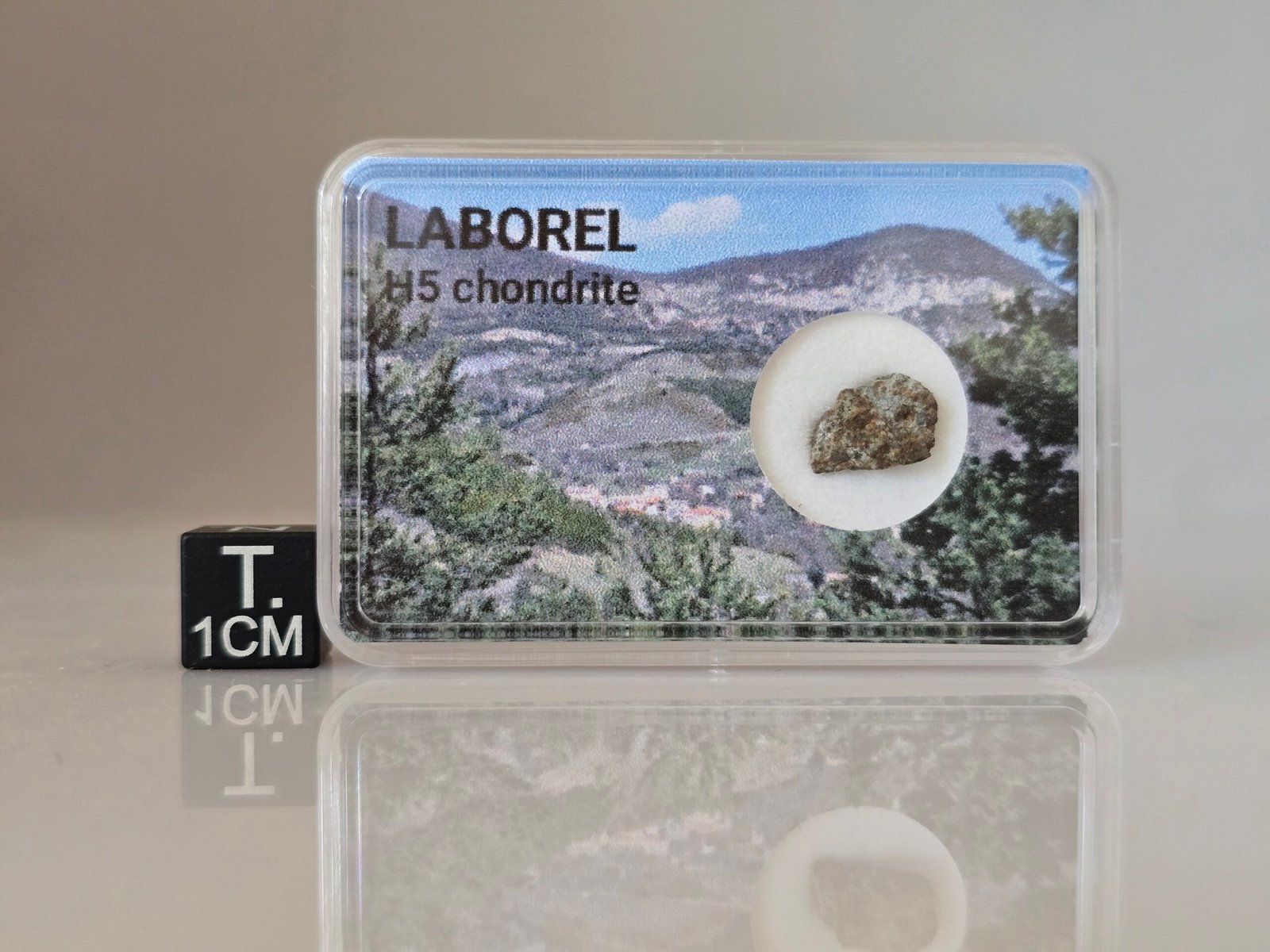
Description
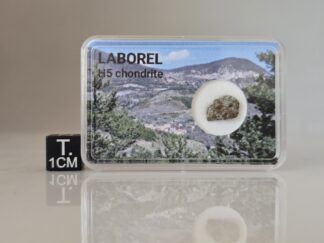
0.355g fragment. Sold in a box with label/certificate.
On June 14, 1871, around 8:00 p.m., a meteor was observed in southeastern France. Little is known about the circumstances of its discovery; we only know that the fall occurred in the hamlet of Les Arnoux, located just over a kilometer west of Laborel. It appears that at least two stones were recovered.
The *Meteoritical Bulletin* cites a total mass of 3.83 kg, but despite my research, I have been unable to arrive at that figure—far from it.
In the absence of further information, we will assume the Laborel fall consisted of a main mass of 2,166 grams and a second stone weighing 91 grams.
The first article regarding the fall appeared in the Valence newspaper *L’Ordre et la Liberté* on June 15, 1871. Another article, published in *Le Petit Marseillais* on June 21, 1871, quotes a witness in L’Isle-sur-la-Sorgue, near Avignon, who observed a fireball moving from west to east at 8:00 p.m. There is also an account from a witness near Étoile-sur-Rhône (in the Drôme department), published in *Le Progrès de la Côte-d’Or* on June 22, 1871. It is highly probable that these accounts relate to the Laborel fall.
At the same time the event occurred in Laborel, a meteor was observed from the Cap Sicié signal station. It appears to pass over the Sainte-Baume Massif, moving from southwest to northeast. The meteor bursts into “a large number of stars of various colors.” Notably, on a map, the locations of Cap Sicié, Sainte-Baume, and Laborel are almost perfectly aligned along a south-north axis. A record of this observation appeared the very next day in the Valence newspaper *L’Ordre et la Liberté*.