


Description
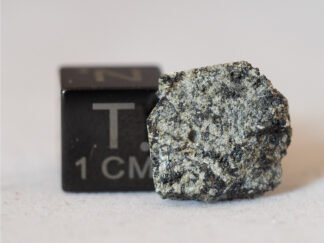
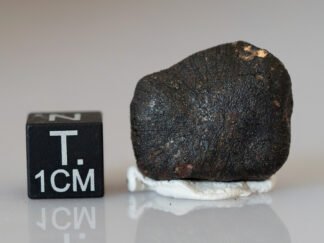
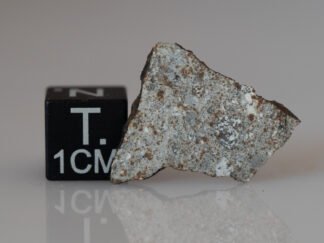
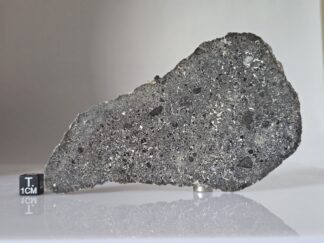
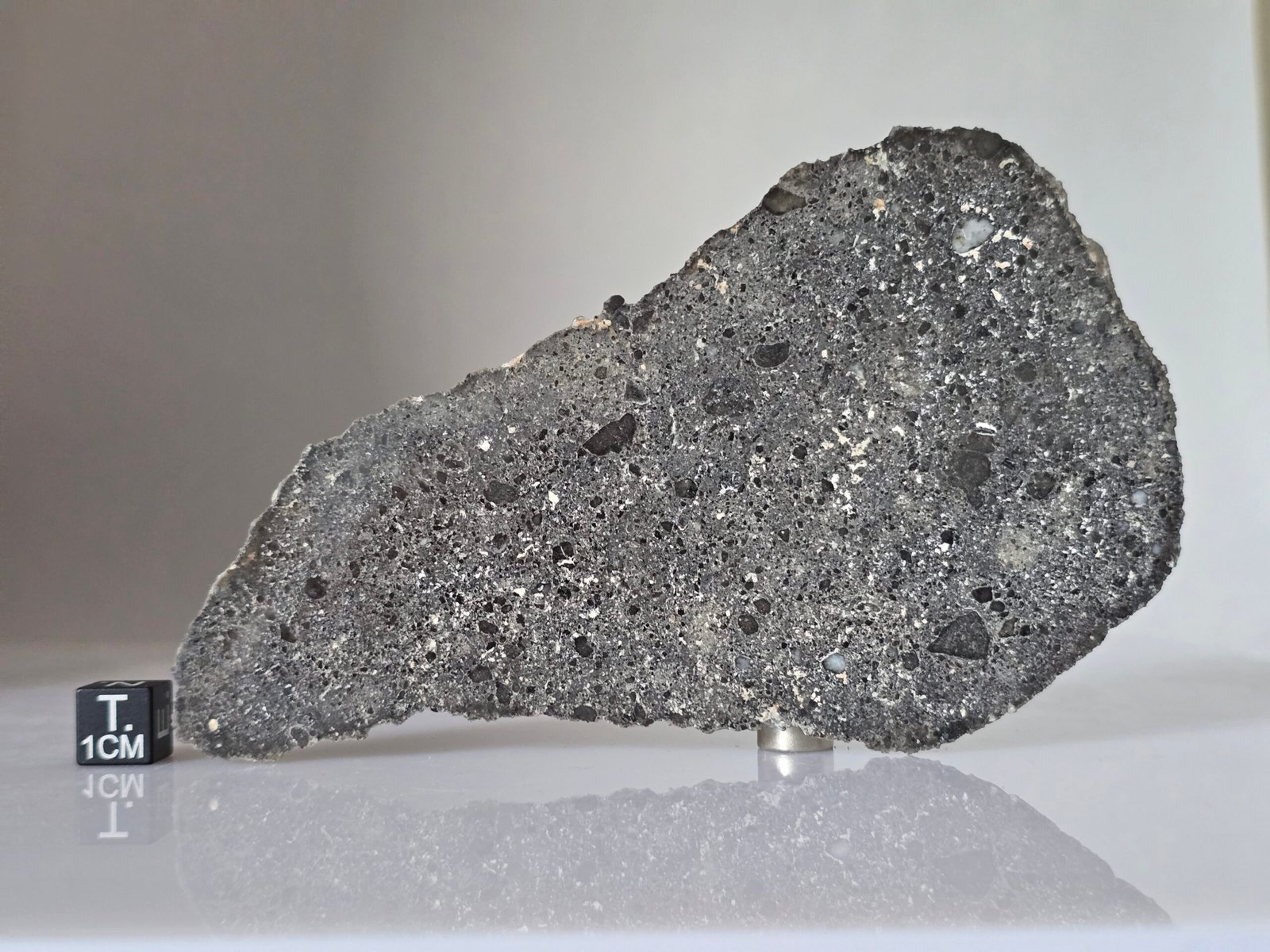
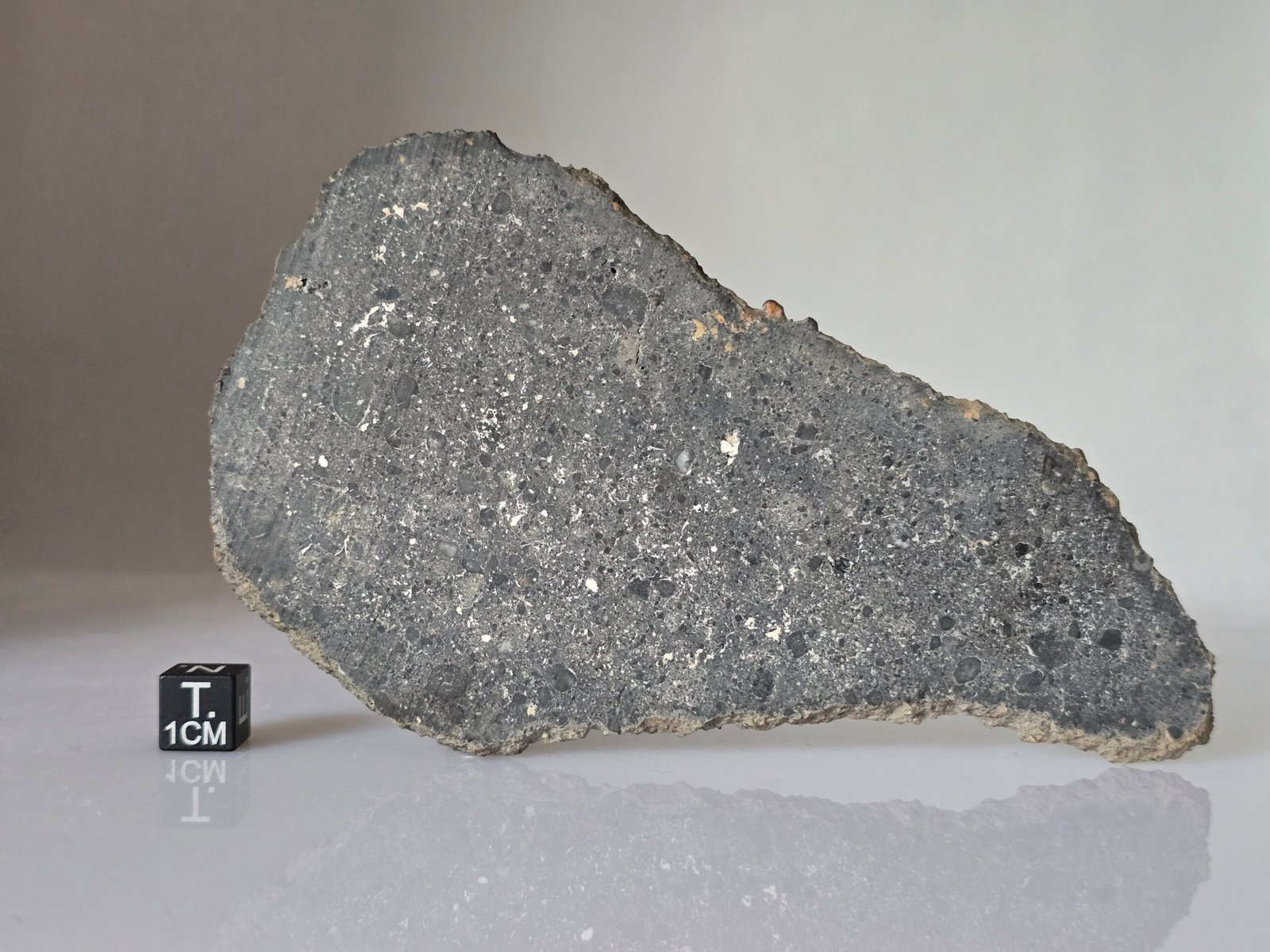
43g slice of this amazingly beautiful lunar. Sold in a box with label/certificate.
Ash Shaqqah 002 is one of the most studied lunar meteorites in recent research.
The alteration formed before the rock was fragmented and incorporated into its present lunar breccia, making Ash Shaqqah 002 one of the strongest known candidates for pre-terrestrial hydrous alteration on the Moon. Researchers have concluded that these alteration features are difficult to explain as ordinary terrestrial desert weathering. Instead, the isolated nature of the altered clasts, together with nearby preserved metallic iron documented in published studies, indicates that the alteration most likely predates the meteorite’s arrival on Earth.
| Writeup from MB 114:
Ash Shaqqah 002 30.304839, 24.71576 Tubruq, Libya Find: 2024 Classification: Lunar meteorite (troctolitic anorthosite) History: On October 10, 2024, while a group of Libyan falconry enthusiasts were searching for birds north of the Jaghbub Oasis on the Libyan-Egyptian border, a 12 kg brownish rock on the roadside caught their attention. They took it with them in the hope it might be a meteorite. When news of its lunar origin was confirmed, the falconers returned to the site with family members, and from mid-October through November most sizable masses were located, including specimens which weighed, 10.5,14, 16.6, 18.9, 19.6, 25.9, 32.9, and 45.7 kg. The largest mass, weighing 48.8 kg, was recovered on November 3. Medium-sized and small fragments continued to be found through December, bringing the total weight to 329 kg. Darryl Pitt acquired 317 kg of material of which The Stifler Collection of Meteorites has 259 kg and MMGM has 58 kg. The strewn field is approximately 5 × 3.5 km. Physical characteristics: These meteorite masses have brown-colored desert-weathered exteriors lacking fusion crust. Saw-cut surfaces reveal a brecciated gray to brown colored interior. Some clasts possess scattered reddish-orange crystals. Petrography: (C. Agee, UNM) This meteorite is a brecciated troctolitic anorthosite with the following approximate modal abundances: anorthitic plagioclase (80%), olivine (15%), and low-Ca pyroxene (5%). Coarse anorthite grains dominate the mineralogy and most olivine grains are sub-mm in size. This is a monomict breccia with olivine and pyroxene occupying narrow compositional ranges indicating a single, pre-brecciation, plutonic lithology. Shock vugs and vesicles are ubiquitous. Plagioclase crystals often line the vesicle walls. Ubiquitous accessory Fe,Ni-sulfide and kamacite were detected. Orange-colored, altered olivines with low microprobe totals were observed within a number of multiphase clasts in this meteorite. In contrast surrounding domains adjacent to these altered clasts possess fresh, unoxidized metal suggesting that olivine alteration is not related to pervasive desert weathering and instead is more likely to have occurred in the lunar environment prior to the assembly of this breccia. Geochemistry: (C. Agee and M. Spilde, UNM) olivine Fa19.1±2.2, Fe/Mn=78±5, n=8; low Ca pyroxene Fs16.9±1.1Wo4.2±0.7, Fe/Mn=50±3, n=5; plagioclase An96.9±0.2Ab3.0±0.2, n=4. Classification: Lunar (troctolitic anorthosite) based on figure 1 in Stoeffler et al. (1980) . This meteorite belongs to the lunar highlands Mg-suite (after Warren, 1993). Specimens: 61.6 g on deposit at UNM. DPitt acquired 317 kg of material of which The Stifler Collection of Meteorites has 259 kg and the MMGM has 58 kg |