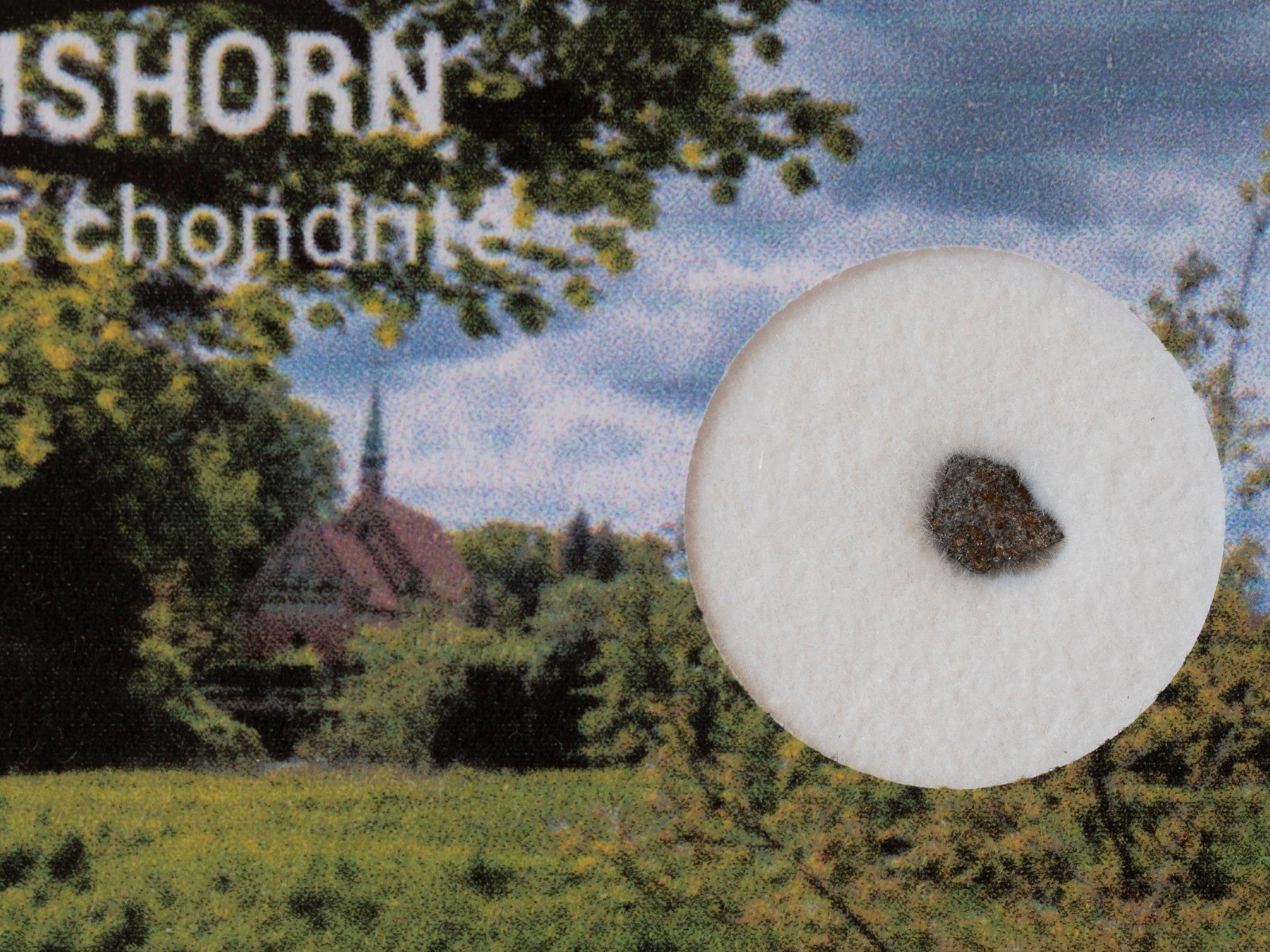
Description
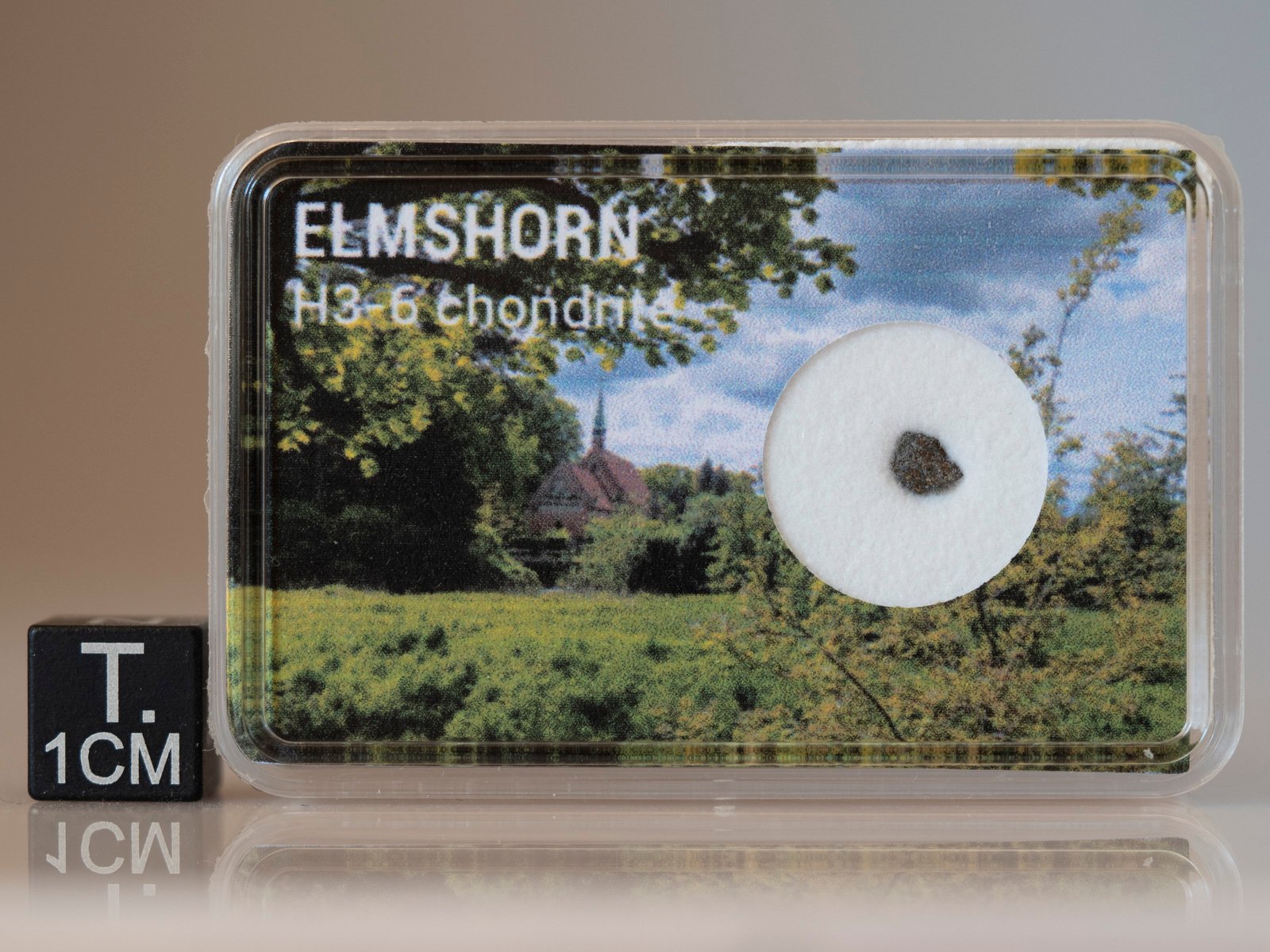
0.028g fragment
Sold in collection box with labels/certificate
Elmshorn 53° 45′ 55″N, 9° 38′ 4″E
Schleswig-Holstein, Germany
Confirmed fall: 2023
Classification: Ordinary chondrite (H3-6)
History: (D. Heinlein) The daylight fireball on April 25, 2023, at 12:14:24 UT was recorded for three secondsduration by two meteor cameras of the Allsky7 network and observed by eyewitnesses in northern Germany and the Netherlands. 117 seconds after the bolide’s appearance, a 3731 g stony meteorite struck an Elmshorn garden. The impact sound was acoustically recorded by a nearby surveillance camera. Shortly thereafter, smaller meteorites hit the roofs of two Elmshorn homes, damaging several roof tiles. One of these stones, a fusion crusted individual meteorite weighing 233.5 g, felt hand-warm for several minutes after the impact as reported by the finder (garden’s owner). Intensive search activities led to the discovery of complete meteorite pieces or their fragments at another 18 locations in the northern city area of Elmshorn.
Physical characteristics: (D. Heinlein) The main mass of the Elmshorn fall, 3736 g, penetrated 40 cm deep into the ground when it hit the lawn of the Mahmut and Güllü Sahin’s garden. The flight-orientated stony meteorite is almost completely covered with a dull black fusion crust and shows pronounced regmaglypts on the front face. The meteorite has a bulk density of 3.338±0.001 g/cm3. The next two largest stones struck rooftops and damaged some tiles, leaving the meteorite of 233.5 g virtually intact, while the 156 g stone shattered into a dozen fragments. By search campaigns within one month, further complete meteorite pieces from 20 g down to 1 g, as well as fragments of splinters could be secured.
Petrography: (M. Patzek and A. Bischoff, IfP) Elmshorn is a chondritic breccia. The inspection of the broken surfaces reveals the brecciated texture with large light and dark fragments embedded in a grayish clastic matrix. The optical detailed study of the thin section reveals that the light clasts are well-recystallized lithologies with barely visible relict chondrules and with large plagioclase grains (type 6), whereas the dark lithology is rich in fine-grained olivine and small skeletal metal grains. The grayish clastic matrix itself is a mixture of lithic clasts of different petrologic types (including type 3 and type 4 clasts with clearly defined chondrules), shock-darkened clasts, fragments of impact melt lithologies, as well as mineral and chondrule clasts. The most abundant opaque phase is kamacite. Taenite, tetrataenite, and troilite are also present.
Geochemistry: (M. Patzek and A. Bischoff, IfP) The mean composition of randomly analyzed olivines in two different samples is Fa19.6±1.5 (n =103) and Fa20.7±2.3 (n = 106), respectively. Detailed studies revealed a range between Fa<1 and Fa32 of olivine within unequilibated components (type 3 clasts). The random analyses of olivine show that most grains plot near Fa19-20, but that a significant number of olivines have Fa-contents of about 22 mol%. In the first sample fragments with mean ~Fa19-20 are dominant (some type 4 clasts have Fa21.5-22 indicating intermediate Fa values between those of H and L chondrites), whereas in the second sample olivines with ~Fa21-22 are dominant, which also have an intermediate composition between those of H and L chondrites (H/L). The randomly analyzed low-Ca pyroxenes of the two different samples have compositions of Fs16.1±2.4Wo1.6±1.4 (n = 78) and Fs16.2±2.8Wo0.8±0.6 (n = 79), respectively. Plagioclase analyses were mainly obtained from a large H6 fragment revealing a mean composition of An11.3Ab86.6Or2. Oxygen isotopes: Pack, T. Di Rocco; UGött) The oxygen isotope composition of eight small pieces (~2 mg each) from two different fragments of the Elmshorn strewnfield were obtained. All analyses plot in the H chondrite field having an average of: δ17O = 2.816, δ18O = 4.056; D’17O = 0.675.
Classification: (M. Patzek and A. Bischoff, IfP) Ordinary chondrite (H3-6, breccia, S2, W0); Elmshorn is a breccia consisting of a mixture of many different clast types ranging from highly metamorphosed type 6 clasts to type 3 clasts with a glassy mesostasis in chondrules. Considering only samples with mass above 3 g, the magnetic susceptibility varies between log χ (× 10-9 m3/kg) = 5.20 and 4.97 (K. Wimmer, J. Gattacceca, CEREGE). Comparing to values for falls of log χ (× 10-9 m3/kg)=5.32±0.10 for H, and log χ (× 10-9 m3/kg) = 4.87±0.10 for L (from Rochette et al, 2003), it is suggested that Elmshorn is a mixture of H and L chondrite components. A similar conclusion is reached by measuring saturation magnetization of ~500 mg samples (J. Gattacceca, CEREGE): Ms=36.5 Am2/kg for the H-dominated lithology and Ms=20.4 Am2/kg for L-dominated lithology, to be compared with values for falls of 40.46±6.99 Am2/kg for H and 17.93±6.09 Am2/kg for L (Gattacceca et al. 2014). The coexistence of typical H chondrite clasts and abundant intermediate H/L (or L) clasts, but without L chondrite O isotope signatures, makes Elmshorn an unusual chondrite breccia. The H-group classification is favored based on the clear and unambiguous O-isotope compositions of different pieces. Elmshorn has a shock degree of S2 (C-S2) considering the undulatory extinction of olivines in many lithic clasts.
Specimens: 20.5 g specimen and several polished thin sections at IfP. Main mass at Museum der Natur Hambrug.